
Atoll Microwave
Atoll Microwave
As 5G makes RAN planning more complex, mobile operators need advanced RAN planning and optimisation tools. Atoll Microwave is a state-of-the-art point-to-point and point-to-multipoint backhaul planning and optimisation software. It allows designing and planning large microwave link networks as required for 5G deployments, according to ITU recommendations, industry standards, and operator guidelines.
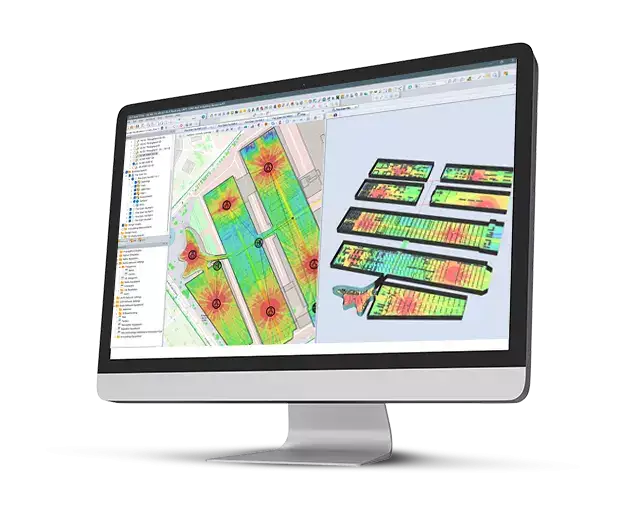
Atoll Microwave Powerful Link Planning Tool
Atoll Microwave is based on the leading Atoll software platform which includes a high-performance GIS and advanced data and user management features. It provides mobile operators with a comprehensive framework for the design and planning of point to point and/or point-to-multipoint microwave links and transmission backhaul.
Full integration of Atoll Microwave with Atoll radio planning modules allows immediate sharing of radio planning and optimisation data for backhaul planning. Atoll microwave also takes advantage of the Atoll platform GIS, user and data management, and reporting features.
Atoll Microwave is being used by a number of major wireless operators and equipment vendors worldwide.

Atoll Microwave also includes a Backhaul Capacity Planning module that allows mobile network operators (MNOs) to model backhaul network topologies and to dimension backhaul links according to the mobile network traffic. The Backhaul Capacity Planning module enables the analysis of end-to-end mobile traffic routing and the optimisation of backhaul capacity. Atoll Microwave also supports non-line-of-sight backhaul enabling small cell planning and 5G network design activities.
Point-to-Point and Point-to-Multipoint Link Modelling
Support of point-to-point and point-to-multipoint links
Modelling of LoS/nLoS/NLoS links using radio, microwave, and mm-wave frequencies as well as wired transmission technologies (optical, copper links etc.)
Support of ITU standard and user-defined frequency bands, high-low configurations, and channelisation plans
Microwave radio and equipment modelling: vendor parameters, IRF, signatures, etc.
Antenna modelling: vendor parameters including co- and cross-polarisation, radomes, etc.
Support for repeaters
Support for space and frequency diversity
Support for dual polarisation
Support for ATPC
Support for adaptive modulation
Support for V-Band and E-Band links
Microwave Link Design
LoS visibility plots
NLoS coverage plots and multipath analysis
Path profile analysis including Fresnel zone clearance with multiple K factors
Off-path profile analysis of Fresnel zone clearance on the horizontal plane
Propagation and link budget analysis
Automatic antenna height optimisation
Reflection point analysis and repeater design
Link network design rules for best frequency band assignment
Link design assistant to solve planning issues
Link Quality and Availability Objectives
Performance objectives based on ITU G-821, G-826, and G-828 recommendations
Performance objectives for IP links based on ITU-T Y.1541 recommendation
User-defined performance objectives and parameters
Link Performance
Based on ITU-R P.530 recommendations “Propagation data and prediction methods required for the design of terrestrial line-of-sight systems”
Support for Crane, Vigants, and K-Q models
User-defined and ITU standard geoclimatic parameters
User-definable reports including multipath, rain, and obstruction fading
User-definable propagation model
End-to-end multi-hop link analysis
Interference Analysis and Link Frequency Planning
Based on ITU-R P.452 recommendation for the evaluation of interference
Detailed interference analysis including interferer ranking
Interactive automatic channels-to-link allocation
Analysis of low/high conflicts
Integration of interference impact into link reliability report
Evaluation of link quality vs. performance objectives
Point-to-Multipoint Link Design and Planning
Modelling of Point-to-Multipoint (PMP) hubs and terminals
Hub coverage predictions
Hub-terminal connectivity analysis
Backhaul Capacity Planning (option)
Modelling of backhaul network topologies and traffic routing
Backhaul network capacity planning and dimensioning
Failure scenario analysis and audit
Customer Story - Optus, Australia
Integrated RAN and Transmission Planning with Atoll MW
Optus, one of Australia’s leading telecommunications operators, required a unified solution to streamline both radio access and transmission network planning. By deploying Atoll MW, Optus successfully integrated microwave and RAN planning into a single environment.
This unified approach enables Optus engineers to design, optimise, and manage both access and backhaul networks within the same Atoll workspace — improving data consistency, reducing planning time, and enhancing overall network efficiency.
The key driver for adopting Atoll MW was the need for a single platform that provides both RAN and transmission planning capabilities, making Atoll the ideal choice for multi-domain network design and optimisation.


Powering the future of mobility with reliable EV charging solutions.

Copyright © 2026 – TeleResources Pakistan. All rights reserved.
Created By Hamza Latif